
SR7 Policy Intelligence Briefing
The fiscal session opened today, and we begin publication of our bill analysis.


The 2026 Arkansas fiscal session officially opened today with a state of the state address from Gov. Sarah Huckabee Sanders to a joint legislative session in the House. Her remarks touched on the war in Iran and touted successes in education and public safety through the passage of the LEARNS Act and the Protect Arkansas Act. She also promised a special session after the conclusion of the fiscal to cut taxes for the fourth time in as many years.
Over the next few days, Tracking Arkansas will release our policy analysis for both appropriation and non-appropriation bills on our Fiscal 2026 Substack. You’ll need to subscribe to this stack separately to get policy analysis delivered directly to your inbox.
Links to our policy analysis will also be available on ArkLeg Bill Tracker, our free online app that allows you to monitor and grade bills and receive email alerts when bills of interest are filed. Take advantage of the full iTrack Arkansas civic engagement ecosystem by signing up for an account today.
SR7: The Good, the Bad, and the Internal Contradiction
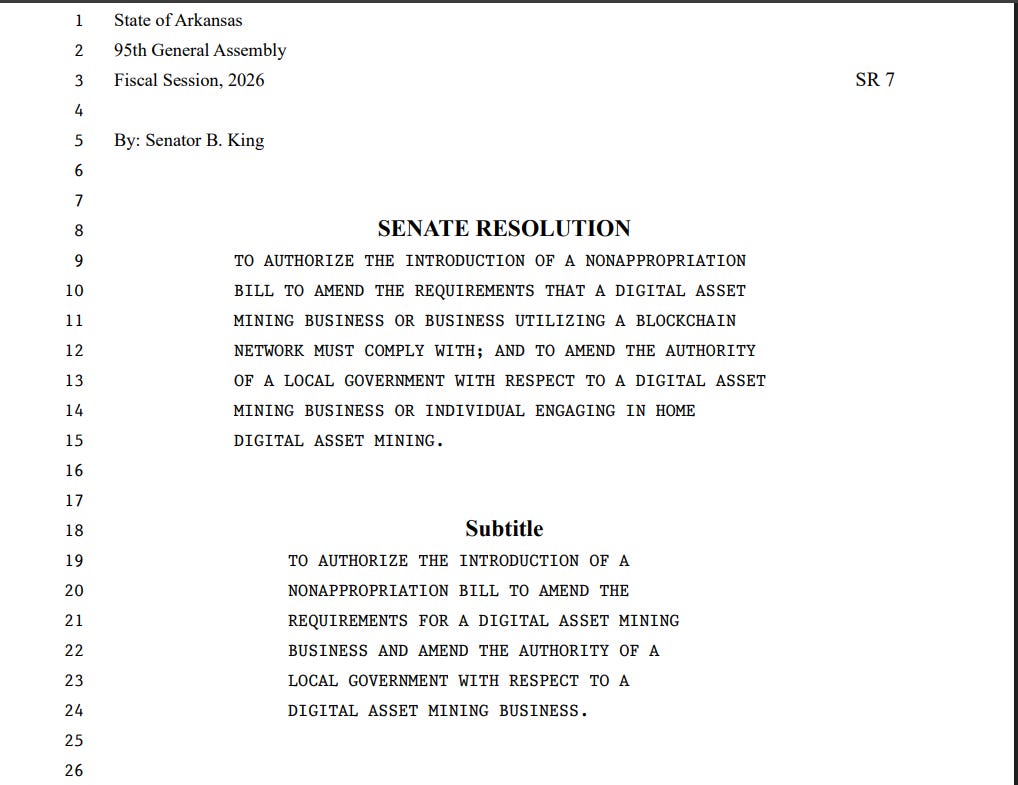
Senate Resolution 7, sponsored by Sen. Bryan King, seeks authorization to introduce a non-appropriation bill for consideration during the session. The resolution has to pass by a 2/3 majority in both houses.
The bill King seeks to introduce would repeal parts of the Arkansas Data Centers Act of 2023 (Act 851) and return power to local governments to regulate businesses and hobbyists engaged in data asset mining and using blockchain networks, which are defined in statute as “a group of computers operating and processing together to execute a consensus mechanism to agree upon and verify data in a digital record.”
The Good
Let’s give credit where it’s due: The underlying bill in SR7 adds protections for water systems. It mandates that a digital asset miner’s operations “causes no stress on an electric public utility’s or water system’s generation capabilities or transmission network.”
Cooling-intensive mining operations can strain rural water districts. This puts water on the same legal footing as electricity.
The bill also restores local governments’ authority to regulate digital asset mining businesses. Act 851 prohibited local governments from limiting sound decibels from home mining. The underlying bill strikes that prohibition.
The Bad: The Blockchain Business Black Hole
The underlying bill adds the phrase “business utilizing a blockchain network” without further definition or carve-outs.
Here’s why that’s a problem: some of the largest companies in the state use blockchain networks.
Walmart is a prominent early adopter of blockchain networks to manage its supply chain. Most notably, they use IBM’s Food Trust Initiative, which uses blockchain networks to help companies like Tyson and Kroger reduce food waste and improve food safety.
JB Hunt was also an early adopter of blockchain for logistics, becoming one of the first five companies (along with Walmart, ArcBest Technologies, Tyson and IBM) to join the University of Arkansas’s Blockchain Center of Excellence Executive Advisory Board in 2018.
Even small businesses that aren’t involved in digital asset mining can use blockchain networks to accept cryptocurrency for payments or to produce limited-edition NFTs.
None of these entities produce digital asset mining noise. None stress electric or water utilities. None operate cooling systems. But under the overbroad “business utilizing a blockchain network” language, they could theoretically be swept into permitting and noise requirements set by local governments.
The bill also gives the Public Service Commission (PSC) rulemaking authority to establish different rates for “a business customer utilizing a blockchain network.” The PSC’s rate-making power would suffer from the same fatal lack of precision.
Recommendation: Strike “or business utilizing a blockchain network” entirely. Use only “digital asset mining business” as defined in §14-1-603, which already includes the use of blockchain networks: “a group of computers working at a single site that consumes more than one megawatt (1 MW) on an average annual basis for the purpose of generating digital assets by securing a blockchain network.”
Permit Authority: The Internal Contradiction
This is the big one. The underlying bill says two directly opposite things about permits for home digital asset mining.
In the bill, Section 14-1-604(c) is amended to state:
”(1) Operating home digital asset mining at the individual’s residence according to applicable utility rules and rates; and (2) Permitting requirements set forth by a local government under §14-1-605.”
Section 14-1-605(a)(4) (as amended) says a local government “may require an individual to obtain a permit to engage in home digital asset mining.”
However, Section 14-1-604(d)(2) (as amended) says a local government shall not pass an ordinance that “requires an individual to obtain approval from a local government before engaging in home digital asset mining.”
Getting a permit is an approval process by definition. A single statute cannot simultaneously say “shall not require government approval” and “may require a permit.”
Recommendation: Strike §14-1-604(d)(2) entirely.
A Step Forward, Tangled in Its Own Language
SR7 attempts to fix real problems. Restoring local control over noise ordinances and adding water system protections are genuine improvements over Act 851. Those provisions deserve recognition.
But good intentions don’t survive bad drafting.
The bill’s fatal flaw is its overreach. By lumping every “business utilizing a blockchain network” under the same regulatory umbrella, it sweeps in Walmart’s supply chain, JB Hunt’s logistics, and a small coffee shop accepting crypto payments, none of which resemble industrial-scale digital asset mining. That’s not precision regulation. That’s regulatory chaos waiting for a court challenge.
Then there’s the internal contradiction on permits, a textbook case of a statute saying “shall not require approval” and “may require a permit” in the same breath. That provision cannot survive legal scrutiny, and it certainly cannot provide clear guidance to local governments or residents.
The bottom line: The underlying bill needs two simple corrections. Strike “business utilizing a blockchain network” throughout. Strike §14-1-604(d)(2). Pass the rest.
Whether King will make those corrections before SR7 reaches a vote is an open question. We’ll be watching, and you can too.
Stay tuned: Tomorrow we’ll follow the money on the LEARNS Act. Subscribe to our Fiscal 2026 Substack for policy analysis delivered straight to your inbox, or track SR7’s progress in real time on ArkLeg Bill Tracker.
 | A guest post by
|
 | A guest post by
|