
Deep Dive: Hamlet's Conflicted Settlement Vote (The Arkansas Machine)
Board of Corrections member fails to disclose conflict of interest with AG's office before voting to accept AG's settlement offer


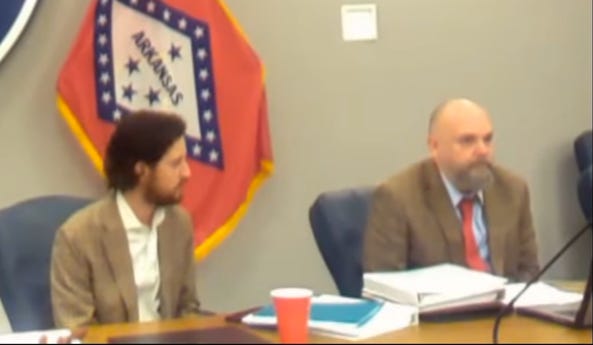
On March 20, the Arkansas Senate voted during a contentious business meeting to confirm Gov. Sarah Huckabee Sanders’ three appointments to the Arkansas Board of Corrections (BOC). Within 10 days, the board would vote 4-3 to settle two lawsuits with Sanders and Attorney General Tim Griffin.
But there is more to this story than a captured board delivering a predetermined result. The deciding vote for those settlements was cast by a member who never disclosed that his wife works for the opposing party. It appears that under Arkansas law, his vote should never have been cast.
The Settlements
At issue are two 2023 lawsuits. The first, filed by the BOC, challenged the constitutionality of Acts 185 and 659 of 2023, which shifted the BOC’s hiring, firing and supervisory authority over the Secretary of the Department of Corrections and the department’s division heads to the governor’s office and the DOC secretary, respectively. Pulaski County Circuit Judge Patricia James ruled in favor of the BOC in November 2025, writing that the laws in question were unconstitutional under Amendment 33.
Griffin filed the second lawsuit against the board, alleging former chair Benny Magness and current member Lee Watson met illegally to discuss hiring outside counsel for the lawsuit against the governor. Pulaski County Circuit Judge Tim Fox dismissed the case on procedural grounds, and the state Supreme Court reversed the decision and sent the case back to the circuit court in May 2025.
Sanders lost in court, so she captured the BOC.
In December 2025, she appointed three loyalists: Jamie Barker, her former deputy chief of staff and a partner at the lobbying firm Gilmore Davis Barker Strategies; Boyce Hamlet, a former Medicaid fraud investigator in Griffin’s office; and Nathan Lee, a deputy secretary of state. A fourth appointee, Grant Hodges, a former state legislator who now works for the lobbying firm JCD Consulting, was appointed in January 2025. Hamlet gained his seat on the BOC as a result of being appointed as chair of the Post-Prison Transfer Board.
On March 30, 10 days after the confirmations of Barker, Hamlet and Lee, the board met to consider settlements that Griffin offered to end the lawsuits. The terms? The board must declare Acts 185 and 659 constitutional and admit that Watson and Magness violated FOIA.
The vote to accept both settlements was 4-3, with Barker, Hamlet, Lee and Hodges voting yes. The three members appointed by other governors voted no. When you can’t win on the merits, replace the opposing team and have them throw the game.
The Conflict
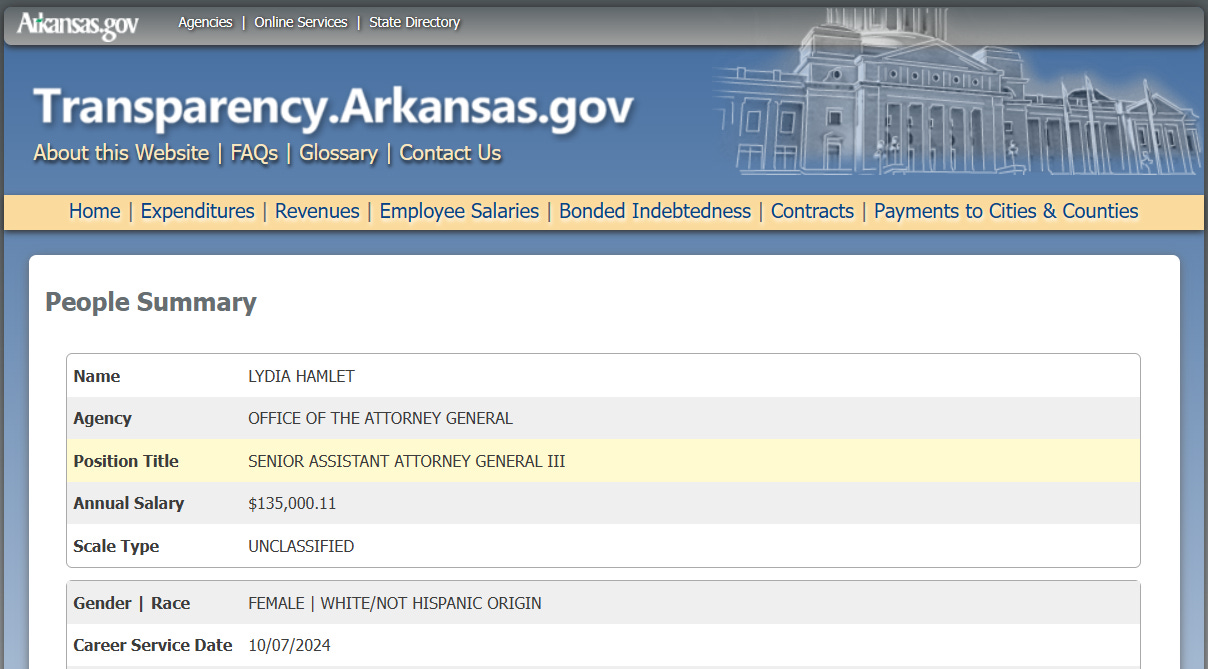
Hamlet’s wife is Lydia Hamlet, a senior assistant attorney general, working in Griffin’s office and making $135,000 annually, according to the state transparency site. On March 13, two weeks before the BOC voted on the settlements, she entered her appearance as counsel of record for the State of Arkansas in Pulaski County Circuit Court in an unrelated case.
Tracking Arkansas first became aware of Lydia Hamlet’s employment with the AG’s office while reporting on the Capital City Tree Service case, for which she is an attorney of record for the AG. We recognized the last name and verified the relationship through Boyce Hamlet’s 2025 Statement of Financial Interest, where she is listed as his spouse.
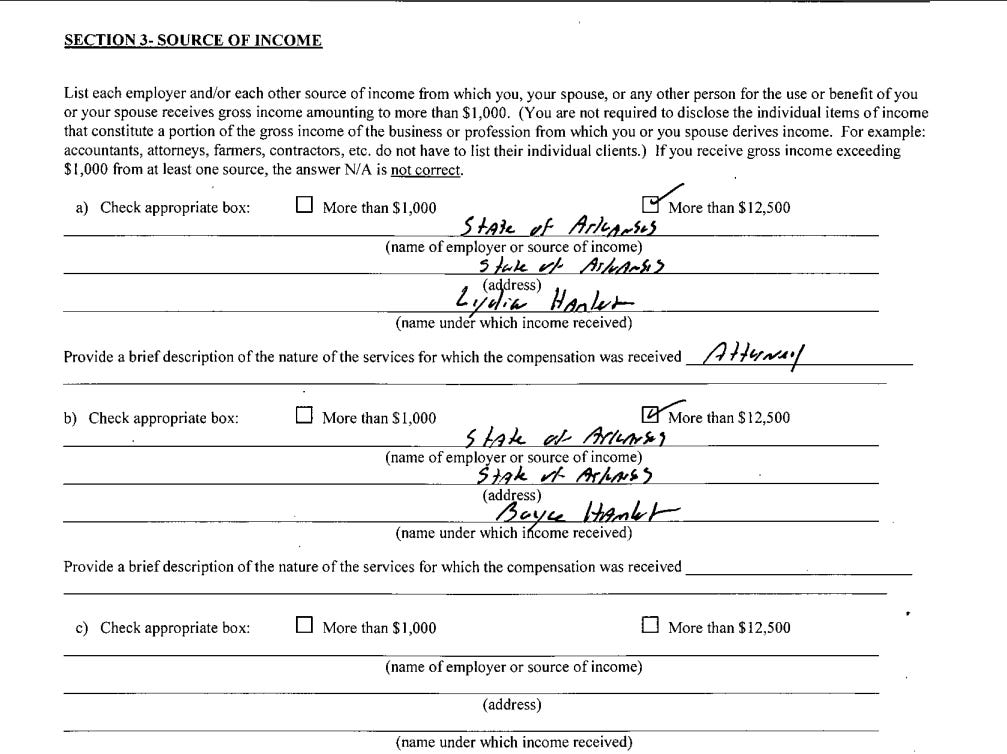
A spouse has a personal and financial stake in their partner’s professional standing, career trajectory, and the institutional success of their employer. Boyce Hamlet voted to hand his wife’s employer and his former employer a legal victory it could not win in court. He did not disclose the relationship before the vote. Neither did the AG’s office.
Had Hamlet disclosed his conflict and recused, the motion to accept the settlements would have failed 3-3.
The Law
Arkansas Code § 21-8-1001(a)(1) is the law governing ethics and conflicts of interest for state board appointees. It provides that no member of a state board or commission shall “participate in, vote on, influence, or attempt to influence an official decision if the member has a pecuniary interest in the matter under consideration.” Lydia Hamlet’s employment with the office that offered the legal settlements the board voted to accept is a pecuniary interest.
The law does include a narrow exception for when the financial interest is incidental to a board member’s job, or if it’s a benefit available to a large category of people, as long as the size of the benefit is similar to that of other people. The financial interest in the Hamlet’s case — Lydia Hamlet’s salary from the AG’s office — is not incidental to her husband’s position, and the particulars of this case go beyond a run-of-the-mill procurement vote.
Ratified in 1942 specifically to prevent executive branch capture of independent boards, Amendment 33 of the state constitution mandates that the BOC remain insulated from precisely the kind of entanglement Hamlet’s vote represents. A board member whose spouse is employed by the opposing party in litigation that the board is voting to settle is not an independent steward of constitutional governance. He is a conduit for the executive branch interest that Amendment 33 was written to exclude.
The AG’s Office and the Unrepresented Board
The ethical problems with how these settlements were negotiated do not end with Boyce Hamlet.
Barker called a special meeting to fire the BOC’s independent legal counsel within hours of taking the chairman’s gavel. The AG’s office then negotiated settlement terms directly with an unrepresented opposing party — a board whose deciding vote would be cast by the husband of one of the AG’s attorneys.
Under the Arkansas Rules of Professional Conduct, it appears the AG’s office had an independent duty to disclose that conflict to the full board before negotiations concluded. That disclosure was not made at the meeting before the vote.
Whether the omission rises to conduct prejudicial to the administration of justice is a question the Arkansas Bar and the circuit court now have reason to examine.
What Cannot Be Settled
The FOIA case was never heard on the merits: The circuit court dismissed the case on a procedural ruling that the AG had failed to comply with a court order. The Arkansas Supreme Court reversed that dismissal in May 2025, holding the circuit court had abused its discretion, and sent it back.
What that means is plain: when the captured board voted on March 30 to admit that Magness and Watson violated FOIA, it was admitting to violations that no court had ever found. Griffin got his admission without ever proving his case.
That is not how due process works. The board cannot consent, on behalf of individuals, to findings that those individuals violated the law. Magness and Watson have moved to intervene in the case, seeking a declaratory judgment that their conduct was lawful and a temporary restraining order blocking the settlement from being fully executed. Fox indicated at the May 4 hearing that he was inclined to allow the intervention and requested briefs from both sides before ruling.
The second settlement asks the Arkansas Supreme Court to accept an agreement that declares that laws a judge already struck down as violations of Amendment 33 are, in fact, perfectly fine. The governor didn’t beat Amendment 33 in court. She replaced the board, had the replacement board surrender, and is now presenting that surrender to the Supreme Court as if it were a legal consensus freely reached.
It was a 4-3 vote. The deciding vote was cast by a man whose wife works for the opposing party. Under Arkansas law, that conflict should have been disclosed, and that vote likely should not have been cast.
A settlement cannot repeal a constitutional amendment. It cannot override what voters ratified in 1942. What Sanders and Griffin are attempting is to launder a political outcome through a legal proceeding — to get a court to bless a result they engineered by capturing the very body that was supposed to be independent of them. They cheated to get there. And the people of Arkansas deserve to know how.
The Arkansas Machine is an investigative series documenting how a network of political dynasties, lobbyists and financiers has turned one of America’s states into a private enterprise — where prisons are profit centers, elections are foregone conclusions, and you are the customer, not the citizen. This is the playbook for the hollowing out of American democracy, written in real time. Find the whole series here.
 | A guest post by
|
 | A guest post by
|